




After Sunset tonight
Published on 26 Jul 2010 at 00:00.
No Comments.
Filed under Constellation, Mars, Mercury, Saturn, Venus.
Monday 26th July 2010
Sunset Planets
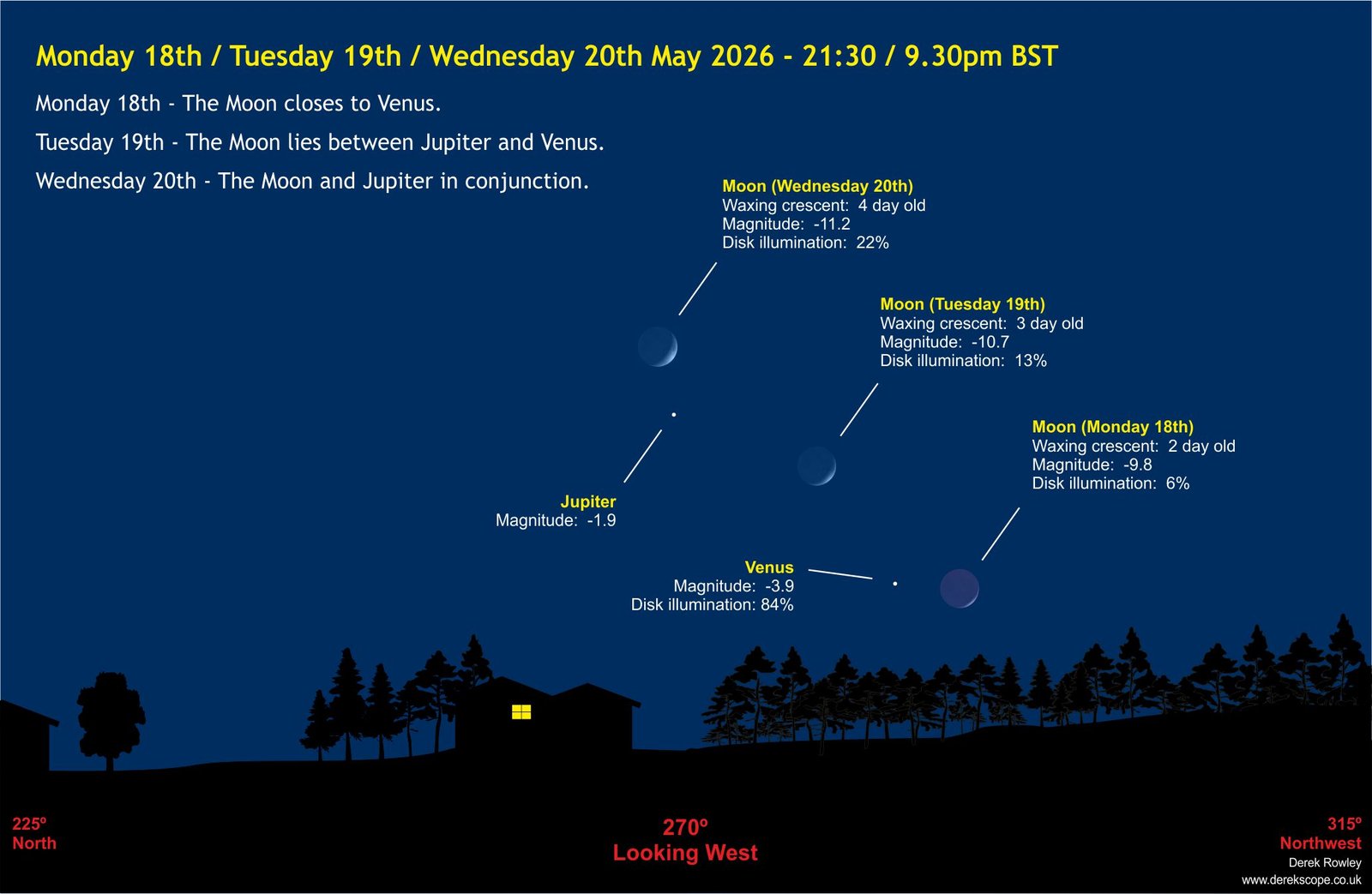
Mars and Saturn are meeting at a particular place with Venus to form a skinny triangle in the sunset sky in the West. When the sun sets tonight, go outside and look West.
Venus pops out of the twilight first, followed by Saturn, then Mars by binoculars or a small telescope.
See the SkyMap for tonight (Monday 26th July 2010), also Friday 30th July 2010 and Saturday 31st July 2010 when Saturn and Mars are only 2o apart.
Moon – Did you know?
Published on 25 Jul 2010 at 00:00.
No Comments.
Filed under Moon.
Sunday 25th July 2010
Could people live on the Moon?
There is no atmosphere on the Moon, so you would not be able to breathe. It is possible to set up scientific bases there, but anyone walking on the Moon would need a spacesuit.
Moon Facts:-
An astronaut last walked on the Moon in 1973.
The Moon is bigger than the planet Pluto.
The Moon is about 230,000 miles from Earth, it would take you more than 9 years to walk to arrive the Moon!
Why is the Moon covered in craters?
Most of the Moon’s craters were caused about three billion years ago by meteorites – these lumps of rock and iron hurtled through Space and crashed into the Moon at high speed – they are continually being hit by objects from Space, most however are smaller than a golf ball.
See the video, the flashing white light was hit the Moon by a small rock.
Does the Moon affect Earth?
Yes! – the Moon has its own gravity that pulls Earth’s seas towards it, making them bulge because of the Earth spins making that bulge moves around the Earth’s surface.
When the Moon is overhead, the sea reaches highest level that when the Moon is over the coast, there is a high tide. It is called Spring Tide.
More information :- Understanding how Tide Cycles follow the moon.
Look for Crater – Schickard Moon
Published on 24 Jul 2010 at 00:00.
No Comments.
Filed under Moon.
Saturday 24th July 2010
Look for crater – Schickard on the Moon tonight.
Schickard is a large old crater with a diameter of 142 miles. When observing Schickard through a telescope, you will immediately notice the absence of central peaks or peak rings. You will also see that there are some large patches of dark and light material on the crater floor.
Schickard is very shallow compared to other craters of this size, only about 1 mile deep. The original crater floor probably has been flooded with lava which covered the central peaks completely. After that a thin layer of bright highland material was thrown like a blanket over the dark crater floor. This bright layer is still visible in the centre of Schickard. Near the edges of the crater (upper left and lower right) there was some additional lava flooding later on. These are the dark patches that can be seen in Schickard.
Wargentin is a very mysterious crater. It seems as if this 53 mile wide crater is filled right up to the rim, looking like a kind of plateau. Wargentin indeed is completely filled, probably with volcanic material, and covered with a layer of brighter highland material. You can see the rim of Wargentin very clearly as well as one or two wrinkled ridges on its flooded floor.
Click here for above enlarge image.
The Moon sits the teapot!
Published on 23 Jul 2010 at 00:00.
No Comments.
Filed under Constellation.
Friday 23rd July 2010 @ 23:00 / 11pm
Click here for enlarge image for tonight you will see the Moon sitting on the top of the teapot in the constellation of Sagittarius (The Archer).
See Derekscope’s archives :- Thursday 22nd July 2010 & the SkyMap, that you will see the Moon has moved.
Look for the Teapot
Published on 22 Jul 2010 at 00:00.
No Comments.
Filed under Constellation.
Thursday 22nd July 2010
The Teapot
A group of eight stars that form the outline of a teapot shape – see the SkyMap for tonight with helping by the Moon to recognise the constellation of Sagittarius (The Archer).
See Derekscope’s archives :- Friday 14th July 2010.
The Gaia Satellite from the UK.
Published on 21 Jul 2010 at 00:00.
No Comments.
Filed under Equipments, Features of Interest.
Wednesday 21st July 2010

The Gaia Satellite from the UK to be launched in 2012 that the new mission to create the largest and most precise three dimensional (3D) chart of our Galaxy by providing unprecedented positional and radial velocity measurements for about one billion stars in our Galaxy and throughout the Local Group.
Click here for movie showing by ESA (European Space Agency) the deployment of Gaia’s solar array and sunshield.
The main structure of the spacecraft was moved this week from the UK factory at EADS Astrium, Stevenage, Hertfordshire, where it has been for a year to undergo tests on its propulsion system then transported by the road to Ampac-ISP at Aylesbury for checks on its cold gas micro-thrusters then after that work is complete – it will move to Astrium at Toulouse in France for final preparations, it will be due for launch in 2012 by a rocket – Soyuz Rocket from the new Sinamary Spaceport in French Guiana, northeast of South America.
Did you know?
Published on 20 Jul 2010 at 00:00.
No Comments.
Filed under Features of Interest, Stars.
Tuesday 20th July 2010

Did you know?
Stars would explode if gravity were not holding their material together!
Atom have gravity, which means that they pull things towards them.
After the Big Bang, gravity made atoms clump together to form stars and planets.
Stars are made of hydrogen and helium atoms but solid planets (Earth, Mercury, Venus & Mars) are made of carbon and iron atoms.
What are planets made of?
Published on 19 Jul 2010 at 00:00.
No Comments.
Filed under Features of Interest, Mars, Solar System.
Monday 19th July 2010
Like Earth, most of the smaller planets in our Solar System have a solid surface made of rock. However Jupiter, Saturn, Uranus and Neptune, the four biggest planets, are made of gases!
Could we breathe on any other planets in our Solar System?
No. One of Saturn’s moons (Titan), may have an atmosphere made of nitrogen gas that making four-fifths of Earth’s atmosphere). However to stay alive that Human needs oxygen.
Is there life on other planets?
All of the planets in the Solar System have been explored with telescopes and space probes – So far, nothing living has been found. The other planets in our system all seem to be too hot, too cold or made completely of gases.
Are there mountains, valleys and volcanoes on other planets?
Yes, Most solid planets have geographical features like Earth.
Scientists have found deserts , polar areas, mountains and valleys on Mars.
Volcanoes have been found on Venus, Mars and Io (one of the Jupiter’s moons).
The biggest volcano in the Solar System – Mount Olympus is on Mars – 16 miles high! and 400 miles wide!
Mosaic Earth
Published on 18 Jul 2010 at 00:00.
No Comments.
Filed under Features of Interest.
Sunday 18th July 2010
Click here for enlarge image.
Credit :- Photographic Mosaic & Digital by Rob Stevenson.
The world famous image has been recast as a spectacular photomosaic that used over 5,000 archived images from NASA of Earth and Space to create the photomosaic as Earth (Blue Marble) was taken from Apollo 17 in 1972.
Rob said, “Please enjoy your stay on Planet Earth”.
Could you create photo mosaics of planets or space with free photo mosaic software?
Click here for a free download software.
What are Saturn’s Ring made of?
Published on 17 Jul 2010 at 00:00.
No Comments.
Filed under Saturn.
Saturday 17th July 2010

What are Saturn’s made of ?
They are made of billions of pieces of ice, dust and rocks.
Some of these particles are as small as a grain of sail, while others are as big as houses.
These are so many of them that the rings look solid.
The rings shine because the ice particles in them reflect light by the Sun (average distance from the Sun :- 888 million miles).
The rings is visible to the naked eye for about 10 months of the year, it appears like a star and takes about 2.5 years to pass through one zodiacal constellation – a binoculars and telescope are needed to make out the ring system.
Saturn is located at the constellation of Virgo (The Virgin), direction at the SouthWest horizon – see the Sky Map.